Doesn’t it sometimes feel like eating healthy is a great mystery? And if you add eating holistically into your quest, the journey can seem even more mysterious and intimidating.
Many don’t know where to start outside of upping their spinach or kale in-take when it comes to pursuing more balanced nutrition.
Taking a holistic approach to eating healthier is simple. It just requires gaining awareness about a few golden rules to get you on your way to Holistic Goddess status.
Eat as close to whole foods as possible
Eating holistically in essence means taking your nutrition to a deeper but also more basic level at the same time. When the choice is available opt to eat whole foods.
Meaning, instead of canned or frozen fruits and vegetables, get them straight from the produce section. Or instead of frozen Lean Cuisine lasagna, make a simple tomato and mozzarella whole wheat pasta dinner.
Herbs Heal
Herbs serve as the foundation for eating holistically. To truly reap the benefits of adding herbs into your holistic eating endeavors, there are three categories of herbs to keep stocked in your kitchen.
Adaptogen herbs strengthen your immune system.
Common adaptogens to have on hand include:
Ginger Root
Maca Root (enhances physical performance)
Maitake Mushrooms
Anti-Inflammatory herbs balance out your digestive system.
Common anti-inflammatory herbs to have on hand include:
Alfalfa (helps to regulate estrogen levels in women)
Cumin
Echinacea
Anti-Bacterial herbs are used in response to a health issue or to prevent them; colds, viruses and allergies, for example.
Common anti-bacterial herbs to have on hand include:
Cayenne pepper
Eucalyptus (a strong cold and flu fighter)
Lemon grass
You can add these herbs into your diet in a number of ways from adding them to your food, to your tea or organic fair trade coffee or water, to taking them in pill form as a supplement.
Eat Throughout The Day
Eating throughout the day is necessary because it helps you to burn calories faster and boosts your metabolism.
A quick eating rule is this:
Eat five small meals a day or three meals and two fruit and vegetable smoothies along with 2-3 glasses of detox water. Ideal detox water combinations include lemons and limes, raw honey and ginger or cucumbers and curry.
To truly take your eating to a holistic level, end your day with a cup of herbal green tea and lemon juice.
Eat Meats That Were Fed A Vegetarian Diet
The phrase, “We are what we eat” couldn’t be more true than it is today. Modern diets now consist of eating meats that are filled with hormones and antibiotics. And if you are eating meats that have been fed processed foods that contain harmful chemicals, then I am sure you can only imagine the unhealthy strain that doing so puts on your body.
However, as consumers we do have choices available to us when it comes to the meats we eat. When shopping buy meats that have the USDA (United States Department of Agriculture) seal of “Vegetarian Fed” or “Grass Fed” on the packaging.
Eating meats that meet this standard is a chief golden rule of eating holistically, because you are eating food that is as close to whole foods as possible. You are eliminating excess toxins from your diet this way, which leads to the next golden rule.
Eat Certified Organic Fruits and Vegetables
The same logic with meats applies to fruits and vegetables as well when eating holistically. When you eat organic fruits and vegetables you are giving your body the opportunity to be nourished at the highest level for optimal health.
To be considered USDA certified organic, fruits and vegetables must contain no pesticides or synthetic fertilizers and have not been exposed to sewage.
They are easy to spot because they will have the 100% USDA Organic sticker on them.
To discover the highest concentration of 100% certified organic fruits and vegetables, visit your area’s Farmers Market. Most Farmers Markets carry a much higher percentage of certified organic produce versus most major grocery stores, where only about 4% of their produce is certified organic.
Ditch The Guilt
This will sound counter intuitive to eating holistically because doing so requires a higher level of self-awareness, but I am going to go ahead and say it, ditch the guilt.
Meaning,
It doesn’t matter if you get your groceries from Whole Foods or Trader Joe’s or the corner bodega.
If you didn’t buy grass fed ground chuck this week, don’t sweat it.
Skip your green smoothie if the idea of eating spinach one more time this week bores you to tears.
Getting healthier and eating holistically can feel like a race towards wellness where bragging rights and self-image are the ultimate wins. However, going that route can lead you to a rabbit hole of choices that may result in guilt when you do have to deviate from your perfect holistic plan.
Ditching guilt is by far one of the most important golden rules of eating holistically for long-term benefits of living healthy.
The golden rules to eating holistically do require some mindful application and commitment, but doing so will allow you to strengthen the foundation of your health.
During your journey keep in mind the ultimate benefits of eating holistically: less stress, better sleep, glowing skin and a balanced digestive system, to name a few.
Once you get into the rhythm of eating holistically your body, mind and spirit will experience newfound radiance, and that is simply golden.
Want to learn more about eating holistically? Well, visit Kick Start Your Health Today and contact CJ for more info. You can also discover more by getting her FREE 30-Day Meal Plan. We’d love to hear your thoughts; please share in the comments.
About the Contributor
CJ Childress is a holistic health coach, indie author and owner of a healthy meal delivery service in Houston, Texas. She began her journey with healthy living as a child by drinking green smoothies and eating organic peanut butter. But after watching her young mother die in 2012 from a rare autoimmune disease she became more convinced than ever that food really is medicine. She works with women to break their addiction to dangerous foods and heal their relationship with their bodies through a fun and focused 60-day transformational program. You can discover more and get your FREE 30 day meal plan by visiting her website HERE.
I don’t know about you, ladies, but I am so thrilled that the New Year is here. Right now is the time that our dreams feel fresh. There’s magic flowing from our pens to our journals. We get our vision board party on, and we make promises to ourselves to start manifesting every day miracles.
Many of us use the beginning of the year to put a tremendous focus on our careers, love life, or other major projects but all too often there is one area of our essence that we neglect.
It’s our bodies.
We make plans to lose weight or go vegan but our actions don’t mount up as the year begins to unfold. Doing so starts to feel too overwhelming all too quickly and before we know it, we are putting our bodies on the back burner.
Excuses pop up. Pain from our past shows up, and guilt about other commitments spring up.
This happens to many of us year after year after year.
Fortunately, we are still very early into 2016 and you can definitely start some new self-love practices right now where your body takes top priority.
These five ideas are easy and not intimidating. Taking care of your body should never be too taxing of an effort when seeking long-term change.
Remember to keep things manageable and uplifting.
1. Hold onto that one healthy habit you already have no matter what.
What do you do now that makes your body feel very loved?
For me it’s cooking healthy meals most days of the week.
Yes, I am going to go ahead and say it: “We are what we eat.”
I want my body to be full of gorgeous foods and nutrients that continuously restore my health.
I put this into practice by cooking my own meals despite the fact that I currently live with my dad who is anti green juice and organic anything and everything. My dad is an award-winning grill master who cooks often, but I stay true to the promise I’ve made to my body and always pass on his offer of pork ribs for dinner.
For you, it may be that you’ve been going to a yoga class once a month, so in 2016 why not go once a week. Even if money is an issue (because honestly, yoga can be quite expensive) find a free class in your city. Meetup.com and yelp.com are excellent resources for finding free classes in most major cities.
Or maybe you desire to try Meatless Mondays and have done it a few times in the past. This year, right now, next Monday is the perfect time to start your Meatless Monday adventure and stick to it.
Zone in on your favorite body-loving practice and remain faithful to it this year.
2. Let go of the negative self-talk about your body
As a health coach, almost without fail, when I work with women, their issue is not being able to control their cravings just for the sake of it. It’s often something deeper that’s holding them back.
In most cases, negative self-talk is at the center of their struggle with self-love and self-acceptance. Granted, speaking so negatively to yourself about your body is still not the root of the issue, it’s just the by-product of pain you may have experienced in your life.
In 2016, let that soul damaging practice go. Take your thoughts to a rewarding place. Reflect on how badass you are at running, teaching, singing, cooking, making love, being a girlboss. If it makes your self-love meter rise, channel that every time nasty self-talk wants to take over your thoughts.
3. Join a spirited and fun health & wellness group online
Community is everything. It reminds you that you are not alone in your daily challenges with loving your body unconditionally. Facebook is probably your best bet for finding a rockin’ group of soul sisters that want to get fit, happy, and more gorgeous, just like you.
When you do find a group, dive in. Don’t be shy. Share your journey. Ask for feedback and suggestions on making healthy body loving changes.
It will feed your body and soul well this year.
4. Always ask “Does my body need this?” when making daily food choices
Mindfulness can be your most reliable game changer when you desire to love your body more. Food that does your body no good will always be there to tempt you. However, you don’t have to let dining anxiety take over.
Quickly ask yourself if what’s in front of you is something your body needs in order to feel more gorgeous. If leftover birthday cake is in the fridge, but an apple and almond butter are also in the fridge, choose the latter. Ask and answer out loud, too. Hearing yourself speak about your options will deepen your mindfulness. Over time, you won’t have the need to ask as often.
5. Re-shape your vocabulary about your body
Banish the word diet and replace it with healthy.
Nix overweight or skinny and say natural beauty.
Forget about ugly and loser and think, authentic.
This little practice alone can probably make the biggest impact on your body love battle in 2016. It’s simple and actionable.
Don’t give power to the words that harm how you love and feel about your body. Positive words are empowering. They will propel you in the right direction. Negative words lead to stagnation and self-sabotage that rob you of beautiful and healthy body-loving journeys.
Use this year to change up your body love story. You only have one so you might as well love it unconditionally with balanced nutrition, healthy thoughts, and motivating self-care practices.
2016 is your year to get more gorgeous and love your body from the inside out.
About the Contributing Writer:
CJ Childress is a holistic health coach, indie author and owner of a healthy meal delivery service in Houston, Texas. She began her journey with healthy living as a child by drinking green smoothies and eating organic peanut butter. But after watching her young mother die in 2012 from a rare autoimmune disease she became more convinced than ever that food really is medicine. She works with women to break their addiction to dangerous foods and heal their relationship with their bodies through a fun and focused 60-day transformational program. You can discover more and get your FREE 30-day meal plan by visiting her website HERE. Connect with CJ on Instagram, too.
Join the Collective on Facebook and Instagram for more inspiration and to stay current on upcoming events.
Wow! Can you believe summer is over? I simply cannot believe how fast it has gone by and that I’m nine months into contributing to The Phoenix Rising Collective. The PRC is inspiring, empowering, and calming, so I hope that my articles have inspired you to incorporate health and wellness into your life resulting in a calm and healthy mind, body and soul.
A few weeks ago I had the opportunity to present at The PRC’s The Fullness of Me workshop. I enjoyed meeting and getting everyone up and MOVING! We had a blast, and I mentioned to the group that physical well-being is directly related to our mental well-being. My goal is to empower all of the workshop attendees and our readers to incorporate movement into their lives. I love it; I really truly do.
I shared two things with the group: 1) I grew up around fitness. I tagged along was dragged along to aerobics classes, gyms and seminars as a kid. As a very young child, my cousin and I would help her mom (my super fitness aunt) lead her classes. And 2) I am a busy working mom of three young children (10, 8, and 5) with an equally demanding husband, and I’m working on a master’s degree. My objective in sharing these “Megan Facts” is to motivate you to move to show your children, grandchildren, nieces, nephews, students, etc. how important it is to be healthy and how to be physically and mentally fit.
Yes, this means leaving the kiddos for an hour in the evening, making the husband or significant other fend for themselves, leaving work on time, or letting the laundry and dusting pile up, but it is well worth the hour of freedom. You will come back refreshed, and you’ll have taught the little ones and others you love in your life that your physical well-being matters.
The reason for telling you about my children, husband and job is that I AM BUSY - so busy, crazy busy, I-want-to-scream-and-run-and-hide busy. I have three children in three different sports plus my girls are in dance classes. My husband works evenings and I manage a global program during the day, BUT I make time for myself and my body. It is my time and I don’t feel guilty about it. We’re all busy in some way, but please make time for your health now; otherwise, you will spend the latter part of your life being busy with doctor’s appointments.
How to Make Time
Remember every movement counts. You don’t have to spend hundreds of dollars per month on a gym membership or equipment. Our body weight is a wonderful tool and will strengthen you and give you the resistance you need.
You can incorporate just 10 minutes a day of anaerobic exercise into your life a few times a week or a 30 to 45-minute workout two days a week and achieve wonderful results and increased energy.
Walk up and down the steps in your house. Grab a chair and sit down and then stand up, repeat. While you’re in the kitchen waiting for the microwave, place your hands on the counter and do push-ups; jog in place while your kids are asking their millions of questions. Break out into Zumba when your favorite song comes on Pandora. While you’re reading, work on stretching. During commercial breaks, do jumping jacks, jump squats, squat walks, bear crawls, lunges, high knees, fast feet. Do something to get the blood flowing.
I hope I have encouraged you to incorporate movement into your life; I hope I have empowered you to know that YOU CAN DO THIS with whatever time or money you have. It will bring peace and calm to your mind, body and spirit.
In health and happiness,
Megan
About the Contributing Writer:
Megan Weidner is a fitness coach and environmentalist in the Akron/Canton, Ohio area. She manages a global sustainability and corporate responsibility program for a large multinational company; her areas include environmental compliance, social equity, community engagement and health and wellness. Megan is also devoted to Rock. It. Fitness., her fitness and natural skincare business. She is committed to making the world a better, more environmentally friendly and healthier place through motivation and education. She is certified through AFAA and Tabata Bootcamp. She has a B.S. in Soil, Environmental, and Atmospheric Science (University of Missouri), a Graduate Certificate in Environmental Management and Policy (University of Denver) and an M.P.A (University of Missouri). She lives in Green, Ohio with her husband and three kids. Read her latest posts.
Your fitness journey is your journey and looks completely different than your sister/mother/best friend/neighbor.
In my professional life I am in the middle of an executive leadership training. With the help of my mentor, we have decided I need to work on patience. Not just how to have it, but the awareness of when it is necessary. So many times in life we want something and we want it now, but in reality that rarely happens. In contrast, there are times when patience is not necessary; we can work hard to get where we want and quickly get there.
I am sharing this lesson this month because it is relevant to health and fitness: There are times when we need to be patient with ourselves but there are also times when we should push ourselves to get to the next level more quickly.
When you start a new fitness program you must have patience; you may have been in the best shape of your life at 20 years old but today is a different journey, a different and new you. It will take a few weeks to build endurance to get back to your higher level, but know that you can get there. Your fitness journey is your journey and looks completely different than your sister/mother/best friend/neighbor.
However, when you’re in the middle of your training, push yourself, do that extra push up or hold that plank for an extra five seconds. This would be a place in fitness where no patience is required. Go for it! Fitness isn’t always comfortable, but it is effective.
I’ve added a video that shows a few exercises to strengthen your arms and legs. Remember to keep your abs engaged in all exercises (in towards your belly button like you are bracing yourself for a punch). When you do the leg workout, stay low with your knees bent. See how many of each exercise you can complete in twenty seconds; recount every other week and watch your progress!
One more quick fitness analogy about goals and patience: In my super-hot and super-awesome yoga class, the instructor had the class doing a very long balance sequence. My leg was burning by the end and my balance looked like I had just taken three shots of tequila. I wasn’t the only person in class struggling during this very hot and very hard sequence. She reminded the class that we needed to focus on something in front of us - not too far in the distance - that was still. Hmm, yes! Was this particular yogi in my executive leadership training call? This is life: Stay focused on a fixed target in your near future that is attainable, but not too far that you lose balance. When your goal seems too difficult and your life is a little wobbly, recommit your gaze to that fixed target. Find your inner strength and keep going. As the instructor also pointed out, if you lose balance and fall a little, readjust. That is OK. That is life. Most people know that adding physical exercise to their daily routine is good for the heart and body, but it is also a mental exercise. When you’re out for a jog, getting down on some Zumba, or listening to the hardest music set you have while completing your bench press set for the day, you are exercising your body AND mind.
I hope each and every one of you finds patience and the awareness of when to have it. Stay strong and on your fixed target. Make the new season about your health and personal fitness goals. Exercise your body and your mind.
In fitness, health and happiness,
Megan
About the Contributing Writer:
Megan Weidner is a fitness coach and environmentalist in the Akron/Canton, Ohio area. She manages a global sustainability and corporate responsibility program for a large multinational company; her areas include environmental compliance, social equity, community engagement and health and wellness. Megan is also devoted to Rock. It. Fitness., her fitness and natural skincare business. She is committed to making the world a better, more environmentally friendly and healthier place through motivation and education. She is certified through AFAA and Tabata Bootcamp. She has a B.S. in Soil, Environmental, and Atmospheric Science (University of Missouri), a Graduate Certificate in Environmental Management and Policy (University of Denver) and an M.P.A (University of Missouri). She lives in Green, Ohio with her husband and three kids. Read her latest posts.
I hope you are having a relaxing, fun, and fit summer! Last month, I talked about finding something that you love. How is that going? I’d love to hear your success stories, so leave your comments below on how you are moving and grooving, staying in shape and loving it.
I found something new that I love. Yoga. Seriously, how have I been a fitness junkie my whole life but never tried yoga?
Like so many other exercises, yoga is perfect for all fitness levels. The great thing about it is that it is a mental workout as well. Your mat is your zone, a time to unwind and release stress, toxins, and any invading thoughts. In the process you gain mobility, flexibility, strength, balance, and energy. I’m telling y’all, it’s good. It can be difficult, but in yoga you are challenging yourself when you are ready. The instructor will lead you with his/her calm voice to a place where you think everything is possible. This sounds too good to be true; I know! But in all seriousness and honesty, yoga is amazing for your body. Practicing can lower blood pressure and anxiety levels and help with sleeping. There are even yoga poses that are said to help with fertility. It is also low impact, and there are kids’ classes (all three of my kids LOVE it, including my ten year old son). I’ve seen chair yoga classes for yogis that find getting to the floor challenging.
I’m still learning about the names of poses, but here is what I’ve learned:
Go to a yoga studio. This is a must to get the full experience. It’s a little more expensive, but you are paying for the relaxing atmosphere which is an essential part of yoga. Nothing against the “Y” or the corner gym, but a studio is best. There’s a lot of deep breathing, so you probably want to inhale relaxing oils and incense, not bleach and sweat.
Give yourself time. There are some serious yogis out there. They have the upper body strength of an Olympic gymnast and are able to balance their whole body on their little finger. Don’t pay any attention to the people around you. It’s your mat, your time, your practice. You’ll get more flexible and stronger the more you practice.
If practicing hot yoga you will sweat – a lot (see Bikram Yoga and Bikram Choudhury). I personally love it because I feel like I’m releasing toxins from my body.
I mean really, truly, let yourself go. This is your time to free your mind of all your worries, anxieties, and stresses. Do not allow work, house, school, or life problems to join you on your mat. When I finish an hour class, I want to give the world a hug. The relaxation is probably the best thing about yoga. You are giving yourself a very physical workout while completely relaxing your mind.
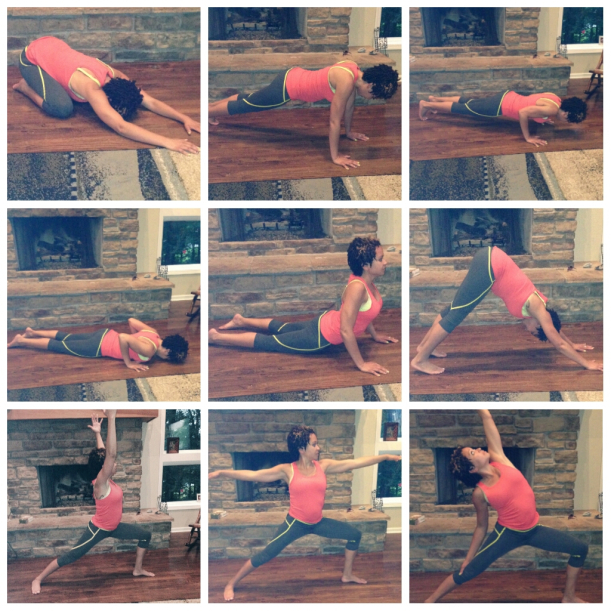
Try this Morning Routine:
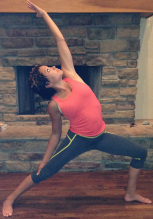
L to R: Child’s Pose, Plank, Chaturanga (photos 3 and 4), Upward Facing Dog, Downward Facing Dog, Warrior One, Warrior Two, Reverse Warrior
The video below also shows the sequence of poses you can do in the morning that will get you started.
When you have gone through each pose a few times end by lying on the floor on your back, arms out to the side, legs open and straight. Take deep controlled breaths and let your mind go. Stay in this meditative state for a few minutes and then get up and conquer the world.
In love, fitness, and health.
Megan
About the Contributing Writer:
Megan Weidner is a fitness coach and environmentalist in the Akron/Canton, Ohio area. She manages a global sustainability and corporate responsibility program for a large multinational company; her areas include environmental compliance, social equity, community engagement and health and wellness. Megan is also devoted to Rock. It. Fitness., her fitness and natural skincare business. She is committed to making the world a better, more environmentally friendly and healthier place through motivation and education. She is certified through AFAA and Tabata Bootcamp. She has a B.S. in Soil, Environmental, and Atmospheric Science (University of Missouri), a Graduate Certificate in Environmental Management and Policy (University of Denver) and an M.P.A (University of Missouri). She lives in Green, Ohio with her husband and three kids.
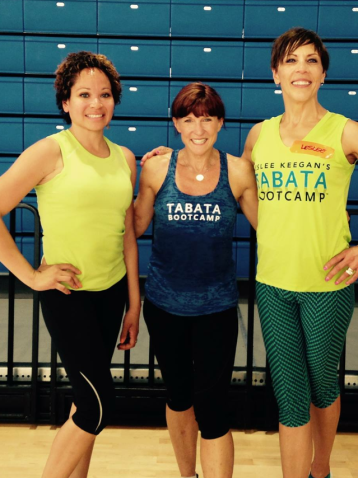
On May 17, 2015, I had the opportunity to do an AWESOME workout session with a well-known trainer, Mindy Mylrea. Mindy is the creator and founder of Tabata Bootcamp. She’s full of energy and excitement and gets her clients motivated to move and live healthier lifestyles. I trained with Mindy two years ago and became certified in Tabata Bootcamp and I use the “camp” with my clients. Tabata Bootcamp is different than any other exercise program I have ever taught or participated in; it is a total body, total mind, and total lifestyle change. The Tabata Bootcamp is different because it can be completed in your home or with a small group of like-minded “campers.” The camp stresses healthy eating, accountability, and simple movements.
L to R - Megan, Mindy Mylrea, creator and founder of Tabata Bootcamp, and Megan’s aunt (also a Tabata Bootcamp instructor and 56 years old, by the way!).
If you don’t love fitness, exercise, or to run, walk, or bike then it is time to find something you like love! Exercise does not have to be boring or mundane or mentally painful! I know lots of people who LOVE and I mean LOVE Zumba because they are exercising and burning calories while gettin’ down, twerkin’ it, and shaking their booty with a group of like-minded, fun people.
If I told you that you could lose ten pounds a month doing one 30-minute workout and five 6-minute workouts a week, you would think, “No way!” We have all been mentally trained to think that running 45 minutes or spending two hours in the gym is the way to looking like J-Lo. We’re all busy: we may have kids; we may have a spouse; we may have a house; we may have a full-time job; and some of us have “e” - all of the above and don’t have time to run forty-five minutes, five days a week.
This is why Tabata Bootcamp is so useful and beneficial: Stay in your home, workout in your office, workout while the kids are reading to you, eat healthy, and use efficient movements to boost your body’s metabolism and oxygen consumption.
Anaerobic exercises push your body out of its comfort zone and challenges your heart, lungs, and muscles to do more. While in the anaerobic zone you burn the most calories and do the most good. In contrast to the aerobic zone, you don’t want to or need to stay in the anaerobic zone very long.
When you’re done, your body enters EPOC, where your body continues to burn calories while it repairs and replenishes oxygen. Because anaerobic exercises are so effective, six minutes a day is all you need. Add in a longer workout such as running, biking or booty shaking Zumba, and healthy eating, and you’ll get fabulous results. My clients lose an average of ten pounds a month using the Tabata Bootcamp system!
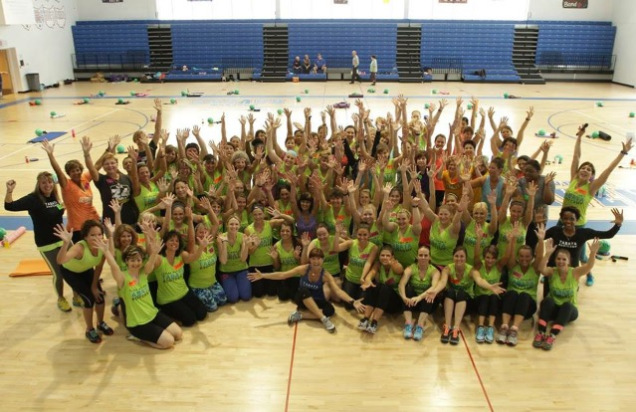
Tabata Bootcamp Workout Session - Group Photo in Ravenna, OH
The point to the long-winded explanation about Tabata Bootcamp is that you should…
Do an exercise that is comfortable for you. If you enjoy running, go for it. If you enjoy yoga, weight lifting, cycling, or Zumba, go for those!
Instead of exercising out of necessity, exercise because it is enjoyable. The more you enjoy it, the more likely you are to stay with it. Did you know that 80% of people who buy a gym membership as a New Year’s resolution stop attending by the fifth month!?! This tells me not enough people are doing something they love.
Add a quick 6-minute workoutlike the one in this video to your morning, lunch break or bedtime routines.
Add an accountability partner to create your own personal success story.
Find a Health & Fitness Coach to support you. If you are interested in learning more about joining Tabata Bootcamp, please contact me. There are camps all around the country or you can try an online option. There are Zumba instructors and personal trainers all around the country as well.
Good luck and keep it moving!
In health and fitness,
Megan
_______________________
Megan Weidner is a fitness coach and environmentalist in the Akron/Canton, Ohio area. She manages a global sustainability and corporate responsibility program for a large multinational company; her areas include environmental compliance, social equity, community engagement and health and wellness. Megan is also devoted to Rock. It. Fitness., her fitness and natural skincare business. She is committed to making the world a better, more environmentally friendly and healthier place through motivation and education. She is certified through AFAA and Tabata Bootcamp. She has a B.S. in Soil, Environmental, and Atmospheric Science (University of Missouri), a Graduate Certificate in Environmental Management and Policy (University of Denver) and an M.P.A (University of Missouri). She lives in Green, Ohio with her husband and three kids.
“Yoga is the Journey of the self, through the self, to the self.” Bhagavad Gita
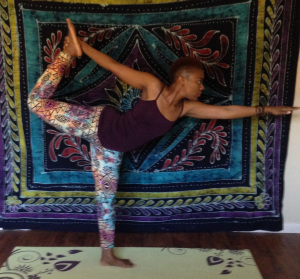
Yogini, KaNeesha in Natarajasana - Dancer’s Pose
One, two, three, four, five…I count silently measuring each inhale and exhale by the rise and fall of my contracting abdomen. Pearls of sweat roll from the widow’s peak of my hairline, down the bridge of my nose, glistening on my upper lip, nuzzling with my chin, and eventually finding respite on the damp towel beneath my left foot. My right leg is extended in mid-air behind me. I’m tightly grasping my right foot with my right hand holding for dear life. I pray to the heavens I don’t lose my balance. I feel strong and confident as I’m holding steady in one of my favorite Yoga asanas: Natarajasana a.k.a. Dancer’s Pose.
Six, seven, eight, nine, ten…my counting is interrupted by a baritone voice gently thundering over the Bikram yoga studio sound system, “Kick, kick, kick aaaand release.” As I mentally prep myself to balance the left side of my body in Natarajasana, I peer around the room and settle my gaze on the 20-something year old crunchy, and the exceedingly hairy white guy in front of me. By the way, crunchy is a term my cousin made up. It describes anyone that falls into the stereotypical “tree-hugger” category: eats granola (hence crunchy), drinks hot tea year-round lovingly clutching their mug with both hands that rock fingerless crocheted gloves, wears Yoga clothes all day (most days of the week), and could easily be mistaken as hippie or any other “crunchy” characteristic across the spectrum. No shade or disrespect. I’m pretty crunchy 50% of the week, but I digress. As I’m attempting to strike an equally fierce Dancer’s Pose with the left side of my body, I sneak a quick glance at the petite white woman standing next to me: not too crunchy but is a beast with the execution of the posture. Then, I’m met with the recurring thought, “DAMN I wish it was some sistahs up in here!” Sistahs, black women, women of color, with mesmerizing hues of sun-kissed bronze and beige skin. Black men, too! Where are the brothas? For this specific class my instructor was a black man (whom for whatever reasons WOULD NOT make eye contact with me, but whatever). Calling out all the brothas, black men, men of color, with cosmic melanin shades ranging from midnight blue to heavenly milky way. As a practitioner of Yoga for the past 10 years (on and off) and a recently certified RYT 200-hour Yoga instructor, I have yet to visit and/or join a studio where minimally 50% of the racial/ethnic demographic looks like me!
I ponder; at what point did Yoga become a sport exclusively practiced by white people, specifically white women? The dominant imagery fed to us by media and marketing sources in the United States is very slim, not-so-crunchy, Lululemon-wearing white women. Public Yogic practices that I’ve experienced - including my instructor certification training - has been comprised of predominantly white women and men, and Asian women coming in second majority; with black women, Asian men, and black men closing out an extremely low population of the statistics. Please note: these statistics are based off my own experience and observation. Yet even more intriguing, while conducting research for this, there was nary a source to highlight the racial breakdown of Yoga practitioners in the U.S.
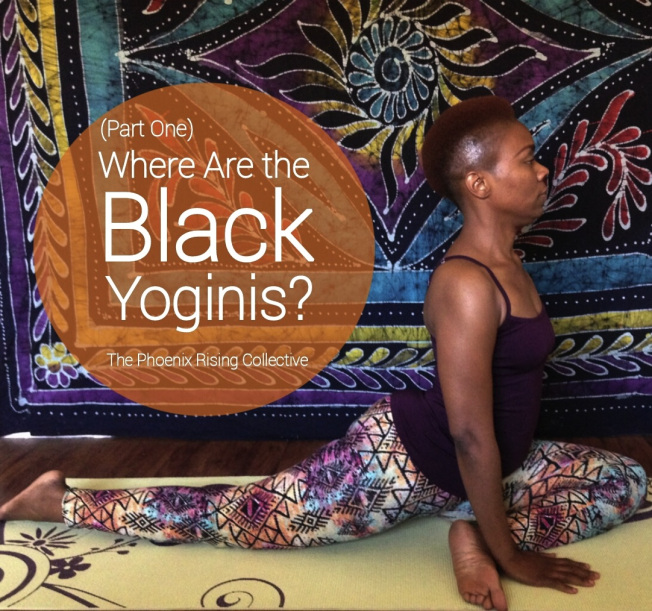
This leads to the title of my article: Where Are the Black Yoginis? Yogini is a term that refers to women that practice yoga extensively. For Part One of this article, I’ll be delving into a brief history of Yoga and how Western practice perpetuates the cultural appropriation of Yoga.
Historical Roots of Modern Western Yoga
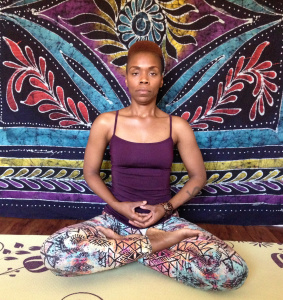
Padma Asana - Lotus Pose
While it is difficult to trace the exact geographical and cultural origins of Yoga, it is said to have been practiced thousands of years ago throughout ancient Egypt a.k.a. Kemet and ancient India. Cultural, religious, and spiritual influences were heavily integrated into the practice of Yoga within both of these areas. This makes the approaches somewhat different. However, prayer and intense study and practice of meditation along with the art of proper breathing are sacred rituals and fundamental components of both. With the exception of certain practitioners (which I’ll discuss in Part Two) many posit the notion that modern day Western Yoga primarily draws lineage from East Indian Vedic spiritual belief system, Hindu culture, Eastern Buddhism, and several other Eastern religious and spiritual practices. Some of the major gurus and yogis of this lineage are Maharishi Patanjali, Paramahansa Yogananda, Swami Vivekananda, T. Krishnamacharya, Swami Sivananda, Sri K. Pattabhi Jois, and B.K.S. Iyengar to name a few.
There were a myriad of connections between these gurus and the Western world stemming from collaborative scientific research based in Yoga, Yoga seminars and retreats held in major U.S. cities, establishment of Yoga studios in the U.S., mentoring and teaching individuals that have become well known U.S. yogis, and a multitude of written publications. The spawn of all this work is Western Yoga. Newly decorated yogis within the U.S. began spreading the Sanskrit “word” - the message of yoking the mind and body through meditative practice and choreographed postures into sequences.
At some point (which I’m still investigating for greater clarity) the major distinction between Eastern and Western Yogic practices became a large omission of prayer, intense study and practice of meditation, and the art of proper breathing. Now, I’m not talking about the quick inhale/exhale breathing that happens for 15 seconds at the beginning and end of a Yoga class concluding with Namaste. Or even the fire breath at the end of a Bikram session (which as a newbie to a class several years ago, I wasn’t even instructed on how to do it appropriately). I am talking about chanting mantras that promote balance, praying to evoke our ancestors, maintaining meditative states of consciousness for hours, and pranayama breathing as a method of healing. In Western Yoga, these have been far removed from the source.
However, there are many exceptions to this including my Yoga Instructor Trainer, Lex Gillan, who founded the Yoga Institute in 1974 in Houston, Texas. Lex is one of the few Western Yogis that has immeasurable appreciation, respect, and admiration for many of the specific elements inclusive to the voluminous Eastern Yogic traditions. Thus, it’s provided him with a robust, impressive, and long-standing personal and professional career within the world of Yoga on a global scale. I’ll discuss more of these “exceptions” in Part Two.
Cultural Appropriation or Cultural Appreciation?
Yoginis - Top Left: Dianne Bondy; Top Right: Queen Afua; Bottom Left: Maya Breuer; Bottom Right: Jana Long
While researching, I was fortunate to uncover a jewel written by Dr. Amy Champ; Race and Yoga: Negotiating Relationships of Power. Dr. Champ is a scholar of feminism, author, speaker, and Yoga instructor. This article summarizes key themes from her dissertation which explores women and Yoga pertaining to race. Dr. Champ references Sociologists and Race Theorists, Howard Winant and Michael Omi’s term racial rearticulation which is used to “describe the acquisition of beliefs and practices of another’s religious tradition and infusing them with new meaning derived from one’s own culture in ways that preserve the prevailing system of racial hegemony.”
I also analyzed numerous sources, their usage and definition of the term Cultural Appropriation. Cultural appropriation is socially defined as, “the adoption of elements of one culture by members of a different cultural group, especially if the adoption is of an oppressed people’s cultural elements by members of the dominant culture.” Oxford Reference suggests that the definition of cultural appropriation includes, “ …Western appropriations of non-western or non-white forms and carries connotations of exploitations and dominance.”
So, considering the history of Western Yoga, the terms and definitions of racial rearticulation and cultural appropriation, it is my summation that Yoga as practiced in the U.S. pervasively demonstrates the acquisition of a singular element from ancient multilayered Eastern religions, spiritual practices, and cultural traditions, and thus has been manipulated to preserve and fortify the dominant racial and socio-cultural hegemonic Western identity. This identity is whiteness. And whiteness being portrayed as the creators and innovators of a way of life that is proven to have existed in different parts of the world B.C.E.
People of color have long suffered from the effects of colonialism, neo-colonialism, imperialism, neo-imperialism, capitalism, all based in racism as unwilling participant-observers whose ethnographies reek of cultural acquisition, demarcation, marginalization, commodification, and exploitation. The constant relegation as other has transcended into marketable products pushed for Western cultural consumption. Thus terms like exotic, aboriginal, African, Asian (as if Africa or Asia is uni-cultural), ethnic-inspired, oriental, tribal, native, etc. have shape-shifted into phantasmasgorias and likenesses wholly detached from the cultures they’ve callously been extracted. Western Yoga is no different.
Generally speaking, Western Yoga is promoted as an exercise and competitive sport with primary focus on executing asanas (postures) with acrobatic and contortionist precision. Accuracy, poise, and form is the crux of what’s taught in many Yoga studios throughout the states, especially the popular ones associated with “celebrity” trainers and practitioners who’ve gained millions in revenue off this one aspect of Yoga. I am of the opinion that this deceptive propaganda postulates a continued blatant disregard for the totality of Yoga.
Minimal consideration is given to various body shapes, weights, sizes, and to how certain modifications may be needed to support reaping the full health benefits of a posture. Or the complete opposite perspective that assumes a fuller body shape, weight, or size is unable to perform certain postures. Again, nary a Yoga magazine, Yoga based website, published article, Yoga clothing ad that features and celebrates women of color, specifically black women. Many black women in the U.S. like Maya Breuer, Dianne Bondy, Jana Long, and Queen Afua to name a few have been long time students, practitioners, instructors, trainers, and Yoga studio owners since the birth of Western Yoga to the present. Drawing from both Kemetic and Eastern traditions, prayer, meditation, and pranayama breathing are integrated into their practices with equal attention given (if not more) to the asanas.
In Part Two of this article, I’ll link cultural appropriation to the mainstream media invisibility of black women in Western Yoga and conclude by highlighting the global movement of Black Yoginis and Yogis.
For now, I’ll leave you with the powerful Oneness; Moola Mantra in Sanskrit:
Om Sat Chit
Ananda Parabrahma
Purushothama Paramatha
Sri Bhagavathi Sametha
Sri Bhagavathe Namaha
OM- We are calling on the highest energy there is
Sat- the formless
Chit- Consciousness of the universe
Ananda- Pure love, bliss and joy
Para brahma- The supreme creator
Purushothama- Who has incarnated into human form to help guide mankind
Paramatma- Who comes to me heart and becomes my inner voice when I ask
Sri Bhagavati- The divine mother the power aspect of creation
Same tha- Together within
Sri Bhagavate- The father of creation which is unchangeable and permanent
Namaha- I thank you and acknowledge this presence in my life and ask for your guidance at all times
______________________________________
About the Contributing Writer:
KaNeesha Allen is an educator and Yogini with extensive community outreach and project management experience in education and non-profit sectors. She is also the mother of two extremely high spirited and intelligent boys – Ausar and Mikah. While often seeking to master the balance between being a highly engaged mother and taking time to BE with herself in the Divine Energy of the universe, KaNeesha finds peace, solace, and regeneration through meditation, Yoga, writing, traveling, and building with her “SiSTARS.” As the Motherhood Empowerment contributor, she welcomes mothers from everywhere to join her on a journey of self-discovery and evolution towards harnessing, embodying, and emoting the Goddess power within.
![Eating Wholistically[blog]The Phoenix Rising Collective](../../2016/03/eating-wholisticallyblogthe-phoenix-rising-collective-e1457468622895_w-150.png)
![Eating Holistically[The Phoenix Rising Collective]](../../2016/03/eating-holisticallythe-phoenix-rising-collective_w-603-h-602.png)
 CJ Childress is a holistic health coach, indie author and owner of a healthy meal delivery service in Houston, Texas. She began her journey with healthy living as a child by drinking green smoothies and eating organic peanut butter. But after watching her young mother die in 2012 from a rare autoimmune disease she became more convinced than ever that food really is medicine. She works with women to break their addiction to dangerous foods and heal their relationship with their bodies through a fun and focused 60-day transformational program. You can discover more and get your FREE 30 day meal plan by visiting her website HERE.
![Body Acceptance [The Phoenix Rising Collective]](../../2016/02/body-acceptance-the-phoenix-rising-collective-e1457061663662_w-150.png)
![Body Acceptance [The Phoenix Rising Collective]](../../2016/02/body-acceptance-the-phoenix-rising-collective-e1457061663662_w-672-h-589.png)
![HealthyWellBeing[The Phoenix Rising Collective]](../../2015/09/healthywellbeingthe-phoenix-rising-collective-e1442868383501_w-150.png)
![HealthyWellBeing[The Phoenix Rising Collective]](../../2015/09/healthywellbeingthe-phoenix-rising-collective_w-611-h-610.png)
![Megan_Weidner[PRC Health Contributor]](../../2013/01/megan_weidnerprc-health-contributor-e1422991035509_w-150-h-139.png) Megan Weidner is a fitness coach and environmentalist in the Akron/Canton, Ohio area. She manages a global sustainability and corporate responsibility program for a large multinational company; her areas include environmental compliance, social equity, community engagement and health and wellness. Megan is also devoted to Rock. It. Fitness., her fitness and natural skincare business. She is committed to making the world a better, more environmentally friendly and healthier place through motivation and education. She is certified through AFAA and Tabata Bootcamp. She has a B.S. in Soil, Environmental, and Atmospheric Science (University of Missouri), a Graduate Certificate in Environmental Management and Policy (University of Denver) and an M.P.A (University of Missouri). She lives in Green, Ohio with her husband and three kids.
Megan Weidner is a fitness coach and environmentalist in the Akron/Canton, Ohio area. She manages a global sustainability and corporate responsibility program for a large multinational company; her areas include environmental compliance, social equity, community engagement and health and wellness. Megan is also devoted to Rock. It. Fitness., her fitness and natural skincare business. She is committed to making the world a better, more environmentally friendly and healthier place through motivation and education. She is certified through AFAA and Tabata Bootcamp. She has a B.S. in Soil, Environmental, and Atmospheric Science (University of Missouri), a Graduate Certificate in Environmental Management and Policy (University of Denver) and an M.P.A (University of Missouri). She lives in Green, Ohio with her husband and three kids. ![fitness journey comparisons[the phoenix rising collective]](../../2015/08/fitness-journey-comparisonsthe-phoenix-rising-collective-e1440706171160_w-150.png)
![fitness journey comparisons[the phoenix rising collective]](../../2015/08/fitness-journey-comparisonsthe-phoenix-rising-collective_w-639-h-638.png)
 Megan Weidner is a fitness coach and environmentalist in the Akron/Canton, Ohio area. She manages a global sustainability and corporate responsibility program for a large multinational company; her areas include environmental compliance, social equity, community engagement and health and wellness. Megan is also devoted to Rock. It. Fitness., her fitness and natural skincare business. She is committed to making the world a better, more environmentally friendly and healthier place through motivation and education. She is certified through AFAA and Tabata Bootcamp. She has a B.S. in Soil, Environmental, and Atmospheric Science (University of Missouri), a Graduate Certificate in Environmental Management and Policy (University of Denver) and an M.P.A (University of Missouri). She lives in Green, Ohio with her husband and three kids.
 ![YogaforBeginners[PhoenixRisingCollective]](../../2015/07/yogaforbeginnersphoenixrisingcollective-e1437427911795_w-108.png)
![YogaforBeginners[PhoenixRisingCollective]](../../2015/07/yogaforbeginnersphoenixrisingcollective_w-598-h-833.png)
![HealthandFitnessTips[thephoenixrisingcollective]](../../2015/06/healthandfitnesstipsthephoenixrisingcollective_w-150.jpg)
![HealthandFitnessTips[thephoenixrisingcollective]](../../2015/06/healthandfitnesstipsthephoenixrisingcollective1_w-598-h-595.jpg)
![Megan_Lunge_Health_and_Wellness[ThePhoenixRisingCollective]](../../2015/03/megan_lunge_health_and_wellnessthephoenixrisingcollective-e1434465146178_w-147-h-256.png)
![BlackYoginis[1]](../../2015/06/blackyoginis1_w-450-h-450.jpg)
 KaNeesha Allen is an educator and Yogini with extensive community outreach and project management experience in education and non-profit sectors. She is also the mother of two extremely high spirited and intelligent boys – Ausar and Mikah. While often seeking to master the balance between being a highly engaged mother and taking time to BE with herself in the Divine Energy of the universe, KaNeesha finds peace, solace, and regeneration through meditation, Yoga, writing, traveling, and building with her “SiSTARS.” As the Motherhood Empowerment contributor, she welcomes mothers from everywhere to join her on a journey of self-discovery and evolution towards harnessing, embodying, and emoting the Goddess power within.